4 min read
Successful Developer Trait #7: Nothing Lasts Forever
Tools, companies, and people all change. The knowledge you pick up along the way will always be useful.
Originally sent in December 2023 as an email course. Updated for 2026.
Hello, hello!
I’m really proud that you make it this far. This is the last issue in the series.
Here’s trait #7 of a successful software developer:
Nothing Lasts Forever
Back when I got my first job in 2015, I worked as a full-stack web developer. The technology used by my company back then were jQuery, Bootstrap, and CodeIgniter.
All of these frameworks, are no longer used widely. jQuery got replaced by React, Vue, and other libraries for front-end development.
CodeIgniter got replaced by Laravel as the most popular PHP framework, but you can also use JavaScript for back-end development using Next.js, Express, or TanStack Start.
And Bootstrap can be replaced with Tailwind or StyleX.
In the world of software development, things usually change once a decade. Back in college (2012), I used a language called VB.NET to write desktop apps for Windows. Today, Electron is the first choice for building desktop apps, or Tauri.
And now even the way we write code is changing. We went from typing every line by hand, to AI autocomplete, to agents like Claude Code that build whole features while we review them. All of that happened in just a few years.
I’m sharing this story with you because I want you to see that in the world of software development, nothing lasts forever. There’s a trend where developers would try to improve the bottleneck of existing solutions, then create a new tool to help everyone do their jobs better.
I know some people in the industry that see all changes as bad. They are comfortable with the tools and knowledge they have, and they don’t want to improve. As a result, their careers are stagnant.
And it’s not just the tools of the trade that changed. Companies also rise and fall. The startup I worked for in 2015 folded in 2020. My friend sold the tech company he started from his bedroom for a good amount of money. The company was then shut down by the buyer.
People also change. I have a friend who had stopped coding when his clothing retail business bloomed. I have a senior who quit her job to become an indie hacker. Still coding, just not on a full-time job. One friend I know started creating a YouTube channel to teach people how to code. His real passion is teaching, and code is just the thing he stuck with. He might teach other things too in the future.
People are all different, and you make your own perfect world. Somewhere along the way, you might realize that there are things you want to do more than telling the computer to do something.
And that’s totally fine. There’s no need to fear you will miss out on great things in life by not coding. You can have another profession, another calling than being a software developer.
I have been coding since 2010, and been working in the industry since 2015. As far as I can see, I will keep coding and making software for the next 10 years. But to be honest, I don’t know if I would still develop web applications in the future.
Maybe the technology we have improved so much that we can code our own robot. Maybe we can start writing applications for rockets because we start colonizing Mars. Or maybe, we can create software that enable space ships to warp drive. Who knows!
Or maybe I would stop writing code and write fictions instead. I have an idea for a science fiction that focuses on the rise of a Robot Empire. It has cool characters and an exciting plot, but let’s stop right there. I don’t want to waste your time by telling you my passion for fictions 😄
I don’t use jQuery anymore, but learning how it works makes me able to see why React was developed. I can appreciate what problems React are trying to solve, while my friends just complained that React was unnecessary and just complicate things.
In fact, it might be that after you finished a bootcamp or an online course, a new trend in web development emerges. But because of the knowledge you’ve gained, you can learn it quickly. That’s what I did with Python and LangChain, by the way:
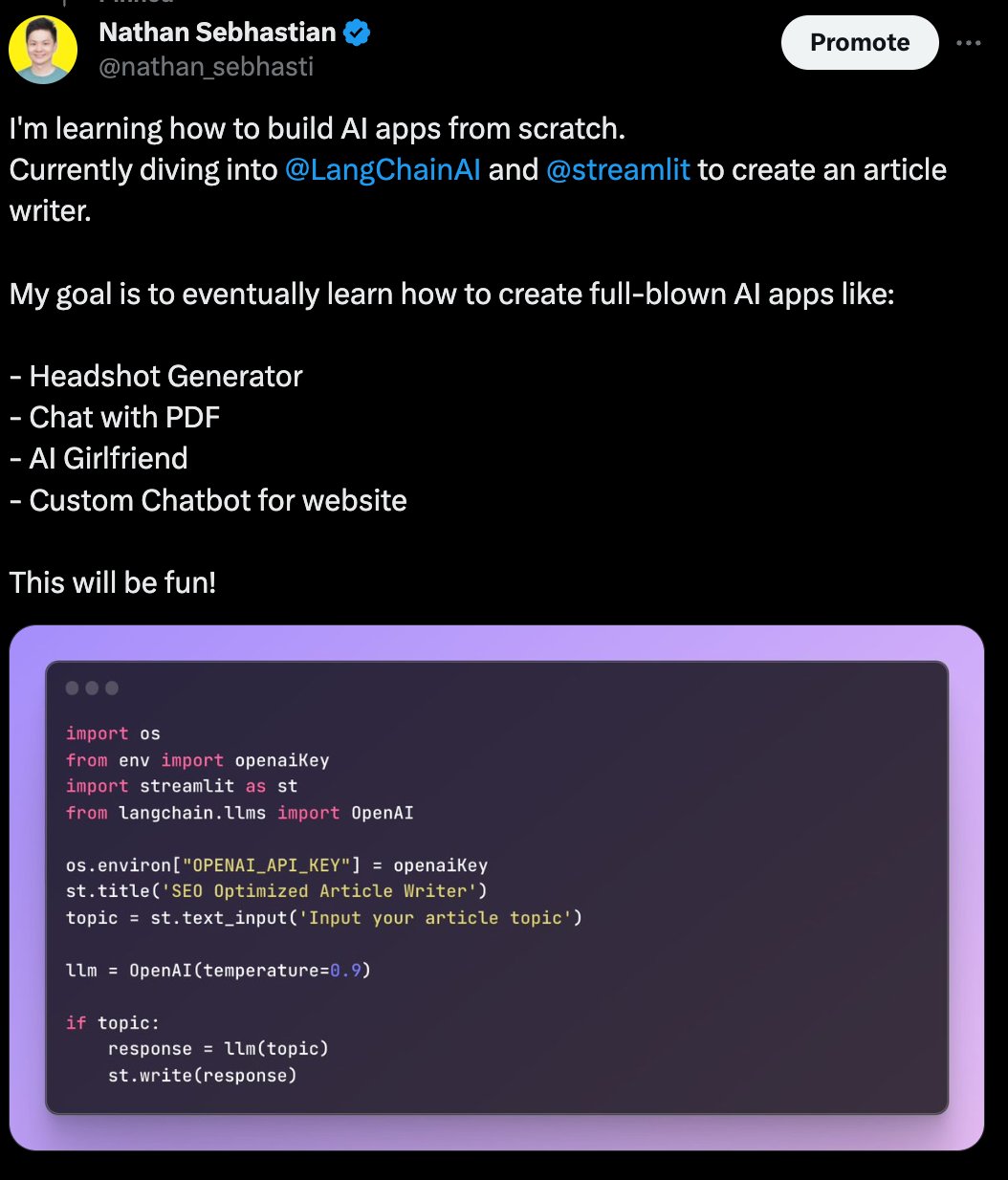
2026 update: I posted that tweet in 2023, and LangChain is still going strong. It’s what I reach for when building Python pipelines for AI SaaS products, and it has grown into a great harness that provides the tools around AI agents. What I learned building that little article writer still pays off every time I build something with AI.
Wherever you are on your coding journey, remember that nothing lasts forever, but the knowledge that you’ve picked up along the way will always be useful.
And there you have it. Those are the seven traits of a happy and successful software developer.
If you enjoyed this series, share it with a friend who needs to hear this. They can start from trait #1.
Thanks again for reading. I appreciate the time you spent on this series.
Stay awesome,
Nathan